
Walking Barefoot on Grass: Ancient Health Benefits Explained
Most people who try walking barefoot outside do it because it feels good and leave it at that. This article goes further. It explains the actual biological mechanism behind earthing — the electron transfer that happens the moment your bare skin meets the earth — and why the research supporting it is more serious than most people realise.

Nate Always
16 min
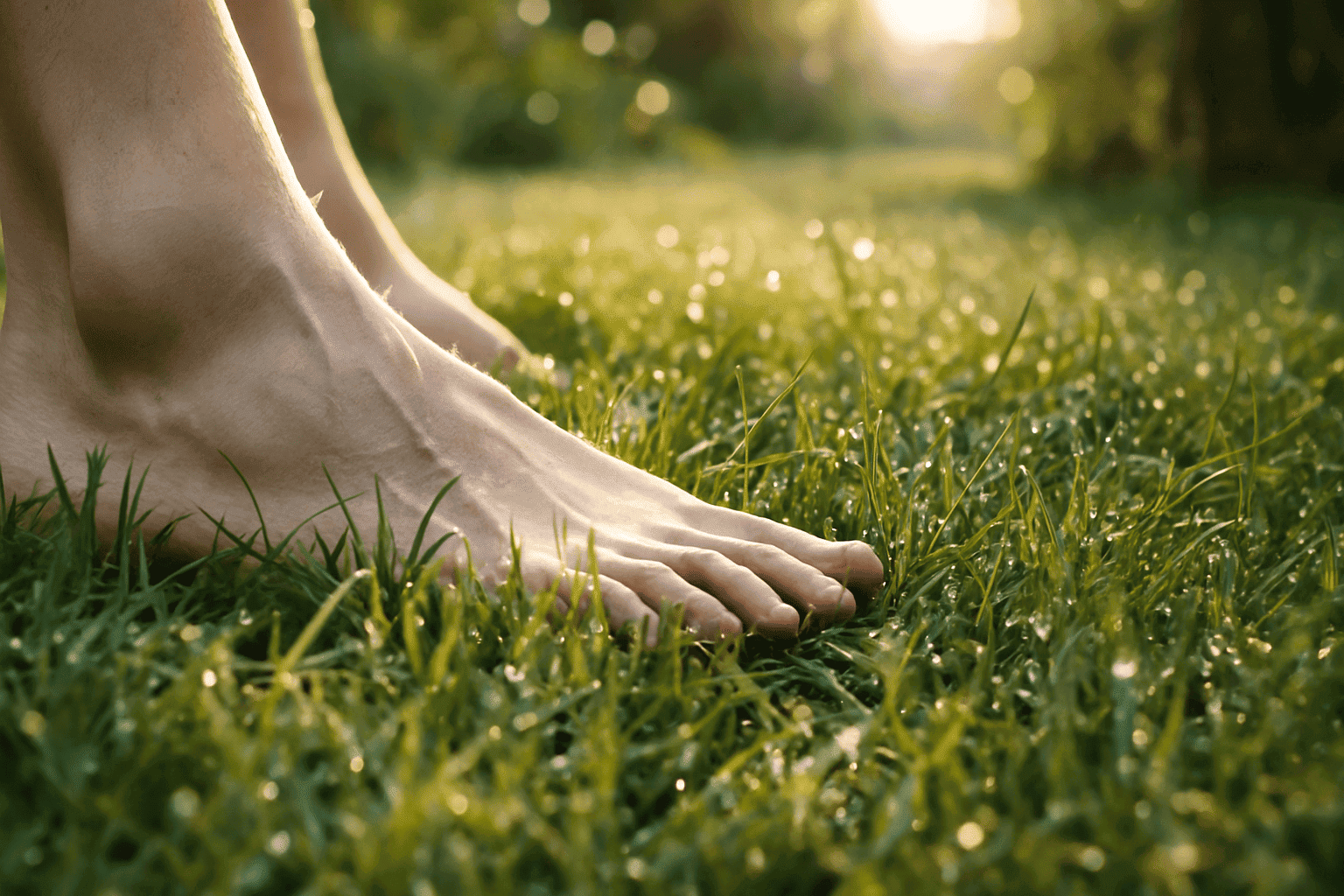
My grandmother never called it "earthing." She had no idea researchers would one day publish papers about it. She just knew that spending time in the garden with her shoes off made her feel better, and she did it every morning without thinking twice about why.
I thought about her the first time I read a study on direct skin contact with the earth's surface and inflammation markers in the blood. Not the way wellness content usually talks about "reducing inflammation," vaguely, without mechanism, as if inflammation is just a word for feeling bad. I mean a specific, testable claim: that contact with the ground changes measurable biological markers.
That caught my attention, because when something your grandmother did barefoot in the garden turns out to have a plausible molecular explanation, it's worth understanding properly. It also turns out to be a genuinely contested area of science, and I think you deserve the honest version of that story, not the tidied-up one.
Here's the mechanism as it's proposed: the earth's surface carries a continuous supply of free electrons. Your body's free radicals, unstable molecules involved in oxidative stress and inflammation, are missing an electron and looking for one. When bare skin makes direct contact with conductive ground (grass, soil, sand, unsealed concrete), the theory goes that electrons transfer from the earth into your body and get absorbed by those free radicals, interrupting the oxidative chain reaction.
The physics behind electron transfer through a conductive surface is real and uncontroversial. Whether that transfer meaningfully changes your biology, at the scale a walk in the garden could produce, is the part that's still genuinely unsettled. I want to walk you through both halves of that honestly.
Key Takeaways
- The earth's surface carries a net negative electrical charge, meaning there's a continuous supply of free electrons available for transfer to a conductive body in contact with it. This part of the physics is well established.
- Free radicals are unstable molecules missing an electron, and they cause oxidative stress by pulling electrons from healthy cells. The proposed idea is that electrons from the earth could satisfy that need directly, though this specific biological claim is disputed by some physicists.
- A handful of small, peer-reviewed pilot studies have reported links between grounding and reduced inflammation markers, changed cortisol rhythms, lower blood viscosity, and better subjective sleep. Most of this research comes from a small group of researchers connected to earthing product companies, and it hasn't been independently replicated at scale.
- You don't need special equipment or a belief system for this to work. If the effect is real, you need bare feet and ground that isn't covered in rubber or synthetic material.
- Shoes with rubber or synthetic soles, which is most shoes made in the last 60 years, electrically insulate you from the earth's surface completely.
Who This Article Is For
This is for you if you've never heard of earthing and the phrase sounds like something from a wellness influencer you don't particularly trust. You're curious about health but skeptical of anything that sounds like it requires crystals or barefoot ceremonies in someone's backyard. You want the biology and the honest state of the evidence, not the hype. This article gives you the mechanism, then the research as it actually stands, including its limits, then the practical application, because that's the order that actually makes sense.
Table of Contents
- The Myth: Walking Barefoot Is Just a Feel-Good Thing With No Biology Behind It
- What Free Radicals Actually Are and Why They Matter
- The Earth's Electrical Surface: Where the Electrons Come From
- The Proposed Mechanism: What's Supposed to Happen on Contact
- What the Research Actually Shows, and What It Doesn't
- Why Modern Footwear Cut Us Off From All of This
- How to Actually Do This, Without Making It Complicated
1. The Myth: Walking Barefoot Is Just a Feel-Good Thing With No Biology Behind It
Let me state the common position clearly, because it's the one most reasonable, skeptical people hold: walking barefoot feels pleasant because of sensory stimulation, fresh air, and the psychological effect of being outside. There's no meaningful biological mechanism beyond that. It's a nice thing to do, not medicine.
That's understandable. The wellness industry has saturated the conversation around grounding with language so vague and earnest that it's made the whole topic feel untestable. "Connect with the earth's energy." "Absorb the earth's healing vibrations." When a real, testable phenomenon gets wrapped in that kind of language, skeptics have good reason to dismiss the whole package.
But dismissing the language doesn't automatically settle whether there's a real mechanism underneath it, and this is a case where the physics is at least partly real.
The earth's surface is electrically conductive and carries a measurable negative charge. Your body is electrically conductive too. Free electrons transfer between conductive surfaces in contact with each other, that part is basic physics, not a claim about "energy healing." What's contested is a specific extension of that idea: that your free radicals, which are electron-deficient and reactive, would preferentially draw from an external electron source like the earth rather than continuing to pull electrons from your own cells. Some physicists have pushed back on this specific step, pointing out that an electron from the ground isn't chemically distinguishable from an electron already present in your tissue.
So here's where that leaves things honestly: the surface physics is solid, the proposed biological consequence is plausible but not settled, and the actual evidence for it in humans is where we need to look next. That's what section 5 covers.
2. What Free Radicals Actually Are and Why They Matter
Before going further, you need a clear picture of what free radicals actually are. This term gets used constantly in health content and rarely explained properly.
A free radical is a molecule with an unpaired electron. Electrons like to exist in pairs. When a molecule is missing one, it becomes chemically unstable and reactive, and it will pull an electron from the nearest available source to stabilise itself. That source is usually a healthy cell in your body.
When a free radical steals an electron from a healthy cell, that cell becomes a free radical in turn, and it steals from its neighbour. This chain reaction is called oxidative stress, and it's one of the primary drivers of cellular damage, chronic inflammation, and biological aging.
Your body produces free radicals constantly as a byproduct of normal metabolism. Every time your mitochondria generate energy, free radicals come out as exhaust. This is normal and manageable, because your body also produces its own antioxidants, molecules that can donate electrons without becoming unstable themselves, to keep the free radical population in check.
The problem is imbalance. Chronic stress, poor sleep, processed food, environmental toxins, and intense exercise without adequate recovery all generate free radicals faster than your internal antioxidant systems can neutralise them. The excess accumulates, oxidative stress becomes chronic, and chronic oxidative stress is one of the underlying mechanisms in a wide range of inflammatory conditions, from cardiovascular disease to type 2 diabetes to accelerated aging.
Antioxidants from food work by donating electrons to free radicals, stopping the chain reaction before it damages more cells. That's the established part of the story. The earthing hypothesis extends this same logic to the earth as a much larger, external electron source. Whether the extension holds up is exactly what the research needs to answer.
3. The Earth's Electrical Surface: Where the Electrons Come From
The earth maintains a continuous negative electrical charge at its surface. This isn't a fringe claim. It's a well-established fact in atmospheric physics, and it's part of why lightning works the way it does.
Here's the condensed version of how that charge is maintained. The earth's surface and the ionosphere (a layer of the atmosphere roughly 80km up) form what physicists call a global electrical circuit. Around 2,000 thunderstorms are active worldwide at any given moment, and each one pumps electrical charge into the atmosphere while returning electrons to the earth's surface through lightning, roughly 40 to 50 strikes per second globally. This constant activity keeps the earth's surface at a negative potential relative to the atmosphere.
In practical terms: the surface of the earth (grass, soil, sand, natural rock, unsealed concrete) is a continuously replenished, effectively inexhaustible reservoir of free electrons at the scale of individual human contact.
When a conductive body, like a bare human foot, touches this surface directly, electrons flow from the higher-concentration zone (the earth) toward the lower-concentration zone (the body) until equilibrium is reached. That part of the process is not meaningfully different from any other conductive contact. The open question, again, is what that electron flow actually does once it's inside biological tissue.
The one thing that reliably stops this contact from happening is an insulating barrier between skin and ground: rubber, synthetic materials, or the sole of almost any shoe made since the 1960s.
4. The Proposed Mechanism: What's Supposed to Happen on Contact
When bare skin, specifically the soles of the feet, which are among the more electrically conductive surfaces on the body, touches grass, soil, or other natural conductive ground, here's the sequence proponents of earthing describe.
Electron transfer begins quickly. Free electrons from the earth's surface move into the body through the skin. Studies measuring electrical potential in the body have reported changes within seconds of contact.
Free radicals are proposed to intercept the incoming electrons, becoming stable, neutral molecules rather than continuing to pull electrons from healthy tissue. This is the step that's biologically plausible but not conclusively demonstrated.
Small studies have reported a drop in inflammatory signals after grounding sessions, including changes in white blood cell activity and cortisol, typically measured within 30 to 60 minutes. These are reported associations in small samples, not confirmed cause-and-effect in large, independently replicated trials.
A shift in nervous system balance has also been reported in a few studies, from sympathetic dominance (the "fight or flight" state many of us live in chronically) toward parasympathetic dominance (rest and repair), alongside changes in heart rate variability, cortisol, and sleep onset. The correlation is documented in the studies that exist; the underlying mechanism for this specific shift is less understood than the electron-transfer story suggests.
5. What the Research Actually Shows, and What It Doesn't
This is the section to read carefully, because earthing research tends to get either overhyped by advocates or dismissed without engagement by critics. Neither response is accurate, and the honest picture sits in between.
Here's the context that matters before any individual finding: the peer-reviewed literature on grounding is small, and a large share of it comes from a tight cluster of researchers, several of whom have direct or historical ties to earthing product companies. Sample sizes are typically in the dozens or fewer. Blinding is difficult to do convincingly in a study where participants can often tell whether they're grounded. Independent replication outside that original research network is limited. None of that means the findings are wrong, but it does mean "peer-reviewed" here should not be read as "settled."
With that context, here's what specific studies have reported:
On sleep and cortisol: A 2004 pilot study in the Journal of Alternative and Complementary Medicine followed 12 people with sleep dysfunction, pain, and stress who slept grounded via a conductive mattress pad for 8 weeks. Their cortisol rhythm shifted toward a more typical circadian pattern, and participants reported improved sleep and reduced pain.[1] It's a genuine finding worth knowing about. It's also a 12-person study with no blinded control group, which limits how much weight it can carry on its own.
On inflammation and blood markers: A broader 2012 review in the Journal of Environmental and Public Health collected the earthing research to that point, including reported reductions in inflammatory markers and changes in blood viscosity across several small studies.[2] The review itself is transparent that most of the underlying studies are small, exploratory, and produced by a limited set of research groups.
What the research doesn't show: Earthing is not a demonstrated cure or treatment for any disease, and none of the available studies claim otherwise when read carefully. Even taken at face value, the studies show physiological changes, not disease outcomes. Some physicists dispute the core mechanism as described. Mainstream medical and scientific opinion is split, with parts of the scientific community treating grounding as an unproven, borderline pseudoscientific claim until better-controlled, independently replicated research exists.
Where that leaves things: the mechanism is physically plausible, a handful of small studies report consistent directional findings, and none of it rises to strong or independently confirmed evidence yet. For something with no cost and no meaningful downside, that's still enough to make trying it reasonable. It's not enough to call it settled science, and TDS won't pretend otherwise.
6. Why Modern Footwear Cut Us Off From All of This
For most of human history, people were in direct, near-continuous contact with the earth's surface. They slept on it, walked on it, sat on it.
That shift happened gradually, but the biggest break came in the mid-20th century with the mass adoption of rubber and synthetic-soled footwear. Before that, shoes were mostly leather, which, worn and slightly moist, conducts reasonably well. Rubber and synthetic materials are effectively complete electrical insulators.
For most people living in industrialised societies today, wearing shoes from waking to sleeping and standing on floors insulated by concrete and carpet, the last time they were electrically grounded to the earth's surface may genuinely have been years ago.
This is not a claim that footwear explains the rise in chronic inflammatory disease. Those causes are multiple and complex, and grounding is, at best, one small factor among many. But it's a factor almost never discussed, and it's trivially easy to test for yourself: take your shoes off and walk on grass.
7. How to Actually Do This, Without Making It Complicated
If you want to try this for yourself, given what the evidence does and doesn't show, here's the practical version. There's no programme to follow, no equipment required, and nothing to buy.
What counts as grounding:
- Bare feet on grass (ideally slightly damp; moisture improves conductivity)
- Bare feet on soil or natural earth
- Bare feet on sand, particularly near the water's edge
- Bare feet on unsealed natural stone or concrete (sealed concrete doesn't conduct well)
- Swimming in natural bodies of water
What doesn't count:
- Bare feet on rubber, synthetic flooring, sealed concrete, or wood
- Socks of any kind, even thin ones, which break the electrical connection
- "Barefoot shoes" with rubber soles. These are good for foot mechanics but don't ground you
On heel pain when walking barefoot: If your feet hurt walking barefoot, particularly on harder surfaces, that's usually a sign they've adapted to the support structure of shoes and your plantar fascia and Achilles tendon need time to adjust. Start on soft grass, keep sessions to 10 to 15 minutes at first, and build up over several weeks.
On barefoot walking pads: Indoor walking pads don't provide grounding. They're rubber-surfaced and not in contact with the earth. They may help with low-impact indoor movement, but they're not a substitute for outdoor barefoot contact.
On grounding socks and mats: Products marketed as "grounding socks" exist, but their effectiveness depends on whether they're genuinely connected to an earth outlet or grounding mat. Regular thin toe-socks provide no grounding benefit at all.
A reasonable starting point: Based on the available research, 20 to 30 minutes of direct skin-to-earth contact appears to be roughly what the studied protocols used. Morning is a convenient time since dew increases conductivity, though the idea that morning grounding specifically interacts with cortisol's natural peak is speculative and less studied than the rest of this.
You can do this while doing something else entirely. Walk slowly, stand still, sit in the garden, read. The activity isn't the point. The contact is.
Frequently Asked Questions
Is earthing the same as grounding? Yes, the terms are used interchangeably. "Earthing" is more common in European and UK usage, "grounding" in North American research. Both refer to direct skin contact with the earth's electrically conductive surface.
How long before I'd notice any effect? Some people report feeling calmer within a single 20 to 30 minute session. The small studies that exist measured biological changes within 30 to 60 minutes in lab settings. Effects on sleep quality or chronic pain, where reported at all, tended to emerge over days to weeks of consistent practice in those studies.
Does it matter where I walk? Is my garden as good as a field? Any natural ground works: garden grass, park grass, soil, sand, natural stone. The specific plot of earth doesn't meaningfully change electron availability. Slightly damp grass conducts a bit better than dry grass, so morning sessions on dewy ground are marginally more effective.
Can I get these benefits from being barefoot indoors? No. Standard flooring (wood, tile, laminate, carpet, concrete slab) either insulates completely or conducts negligibly compared to direct earth contact. Indoor grounding requires a dedicated mat connected to a wall earth outlet, which some studies have used, but it's a different setup from walking outside.
Is it safe to walk barefoot on grass? For most healthy adults, yes. Check the surface for sharp objects first, be aware of pesticide or chemical treatment on public grass, and build up gradually if your feet aren't used to being unshod. People with diabetic neuropathy or reduced foot sensation should be cautious and check with their doctor first.
What about walking barefoot on a walking pad? Walking pads have rubber or synthetic surfaces and aren't connected to the earth's electrical field, so they don't ground you. They may still be useful for low-impact indoor movement.
Do children naturally do this already? Often, yes. Kids who play barefoot outdoors are grounded as a byproduct of how they play. Whether that instinct carries any measurable health benefit isn't something the current research can confirm, but it's a reasonable observation.
Is there any risk to doing this too much? No documented risk from excess grounding shows up in the available literature. The mechanism, as proposed, is self-limiting: your body equilibrates and no further transfer occurs once charge balance is reached. There's no evidence that more time grounded produces more effect once you're past the initial contact window.
What to Do Next
- Start tomorrow morning. Before anything else, take your shoes and socks off and stand on grass, soil, or natural ground for 10 minutes. That's the entire starting point.
- Build toward 20 to 30 minutes of daily contact if you find it worthwhile. It doesn't have to be continuous. Two 10 to 15 minute sessions works just as well.
- If your feet are uncomfortable, start on soft grass only and keep early sessions short. Most people adapt within 2 to 4 weeks of gradual exposure.
- If you want to see whether it does anything for you personally, note your sleep quality, morning energy, and any chronic pain before you start, then check in after two weeks.
- Avoid treated grass where you can, particularly parks or sports fields that may use synthetic pesticides.
- If outdoor grounding isn't accessible regularly, a grounding mat connected to a wall earth outlet is the indoor alternative used in some of the sleep studies, though treat outdoor contact as the primary option.
- If you have a foot condition, circulatory issue, or diabetes, talk to your doctor before changing your footwear habits.
Sources
- Ghaly, M. and Teplitz, D. "The Biologic Effects of Grounding the Human Body During Sleep as Measured by Cortisol Levels and Subjective Reporting of Sleep, Pain, and Stress." Journal of Alternative and Complementary Medicine, 10(5), 767-776 (2004). https://pubmed.ncbi.nlm.nih.gov/15650465/
- Chevalier, G. et al. "Earthing: Health Implications of Reconnecting the Human Body to the Earth's Surface Electrons." Journal of Environmental and Public Health (2012). https://www.ncbi.nlm.nih.gov/pmc/articles/PMC3265077/
This article is for informational purposes only and does not constitute medical advice. Always consult a qualified healthcare professional before making changes to your health regimen.
Tags:
oxidative stress
inflammation
Natural Health
barefoot walking
earthing
grounding
reduction
sleep optimization
ancestral health
walking benefits
outdoor wellness
free radicals